 by
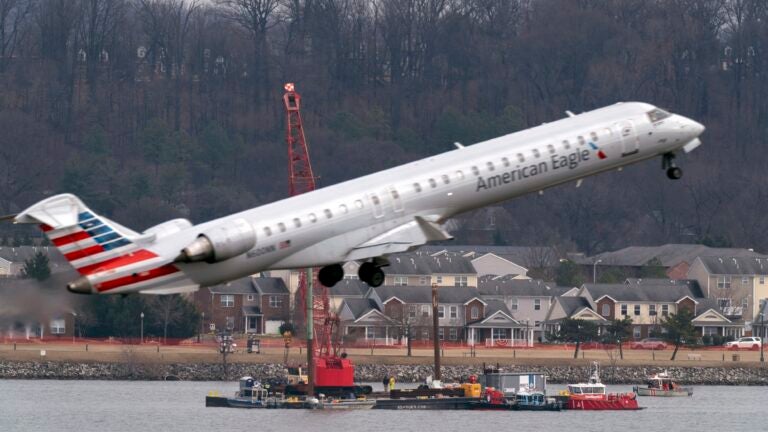
by Investigators looking into the January midair crash that killed 67 people over Washington between an Army helicopter and a passenger airliner discovered that the altitude readings were off and the chopper was flying higher than it should have.

The information was released during the first day of hearings held by the National Transportation Safety Board in Washington. The purpose of the hearings is to help investigators learn more about the circumstances surrounding the collision between the Black Hawk helicopter and the American Airlines aircraft from Wichita, Kansas, over Ronald Reagan National Airport.
In addition to questioning witnesses and investigators regarding the potential roles played by the Army and the Federal Aviation Administration in the nation’s deadliest plane crash since November 2001, the board began the three days of hearings by playing audio and video from the night of the collision and displaying an animation.

The board is probably too early to determine what caused the crash.
Although statistics continue to demonstrate that flying is still the safest mode of transportation, the January incident was the first in a series of crashes and near-misses this year that have worried officials and the traveling public.
Animation, altimeter discrepancy

A video animation demonstrating the location of the airplane and helicopter before to the crash kicked off the hearing on Wednesday. It demonstrated how, before colliding with the jet, the helicopter had flown beyond the 200-foot (61-meter) altitude limit on the helicopter route along the Potomac River.
According to investigators, the flight data recorder revealed on Wednesday that the helicopter was actually 80–100 feet (24–30 meters) higher than what the pilots believed the barometric altimeter indicated they were flying. Thus, in a fly over the same region, the NTSB tested three additional helicopters from the same unit and discovered same inconsistencies in their altimeters.
According to Dan Cooper of Sikorsky Helicopters, the Black Hawk helicopter that was involved in the crash was designed in the 1970s using an altimeter style that was popular at the time. In order to provide more accurate altitude measurements, modern helicopters are equipped with air data computers, which were nonexistent in the past.
Chief Warrant Officer Kylene Lewis informed the board that she would be depending more on the radar altimeter than the barometer altimeter at lower altitudes, therefore she wouldn’t find an 80–100 foot difference between the various altimeters on a helicopter concerning. Lewis stated that she would be cross-referencing and verifying both instruments below 500 feet (152 meters).
According to her, an altimeter is deemed accurate under the checklists if it records an altitude that is within 70 feet of the published altitude prior to departure.
Because pilots are supposed to maintain their altitude plus or minus 100 feet, Army authorities stated that a disparity of 70 to 100 feet (21 to 30 meters) between the Black Hawk’s altimeters is within an acceptable range.
The FAA-approved routes surrounding Reagan Airport that had such short spacing between helicopters and planes during plane landings are of more concern.
“I’m concerned that we have less than 500 feet between us,” said Army Sgt. Scott Rosengren.
However, Rosengren stated that if he were king for a day, he would promptly retire all of the older Black Hawk models, including the one that was involved in this disaster, and swap them out for more recent models.
The published helicopter routes around Washington, D.C., would allow planes and helicopters to regularly land within 75 feet of one another, as previously noted by NTSB Chairwoman Jennifer Homendy.
Army authorities stated on Wednesday that although the flying manual for these older Black Hawks does not specifically address the altimeter inconsistencies that have been previously observed, normal flight separations around airports are at least 500 feet (152 meters).
The helicopter pilot twice informed the controller that they observed the airplane and would avoid it in previously released air traffic control recordings. Surveillance footage of the chopper and plane merging in a fiery crash marked the animation’s conclusion.
Investigations have already revealed that the Army’s helicopters frequently circled the nation’s capital with a crucial piece of locating equipment, known as ADS-B Out, turned off, and that the FAA was unaware of a concerning history of 85 near misses near Reagan Airport in the years prior to the collision.
Bob Clifford, an aviation lawyer who plans to bring one of the first cases against the government next month, expressed his hope that the NTSB will examine the larger, persistent issues in the congested Washington airspace rather than just the immediate causes of this disaster.
Proposed changes
U.S. Sen. Ted Cruz introduced legislation Tuesday requiring all aircraft operators to use both types of ADS-B, or Automatic Dependent Surveillance Broadcast, the technology that broadcasts aircraft location data to other planes and air traffic controllers, even though the final NTSB report won’t be released until sometime next year. Airlines would need to outfit their aircraft with the more complete ADS-B In technology, even though the majority of aircraft now have ADS-B Out equipment.
Cruz asserted that a double standard in aviation safety is impossible. Special exceptions for military training flights flying in crowded airspace should not be allowed.
The bill would remove the Department of Defense aircraft’s exemption from ADS-B communication demands. Additionally, it would mandate that the Army Inspector General examine the Army’s aviation safety procedures and that the FAA assess helicopter routes close to airports.
According to Homendy, following multiple other crashes, her agency has been advocating for that step for decades.
Although he would like to talk about some changes, Transportation Secretary Sean Duffy stated that the law is the correct course of action. In addition, he implied that the previous government was not paying attention to the numerous near-misses that occurred in the airspace surrounding Washington.
Fact-finding proceeding
According to Homendy, the hearings that will take place over the following few days will be a fact-finding process. Additionally, hundreds of pages of the crash investigation’s evidence will be made available online by the NTSB.
According to FAA Administrator Bryan Bedford, he anticipates that during the next two and a half days, we will have some very uncomfortable conversations. However, he stated that these conversations must take place in the open and that we should prioritize the needs of the traveling public over our own interests.
Board members of the NTSB, investigators, and witnesses from the crash-related organizations are all present at the hearings in Washington.
Concerns have also been expressed by federal officials regarding the country’s antiquated and understaffed air traffic control system. One controller was managing both commercial airplane and helicopter traffic at the crowded airport when the mid-air tragedy occurred above Washington in January.
This story was written by Rio Yamat, Ben Finley, and Leah Askarinam for the Associated Press.
Extra News Alerts
Receive breaking news as it happens.