
 by
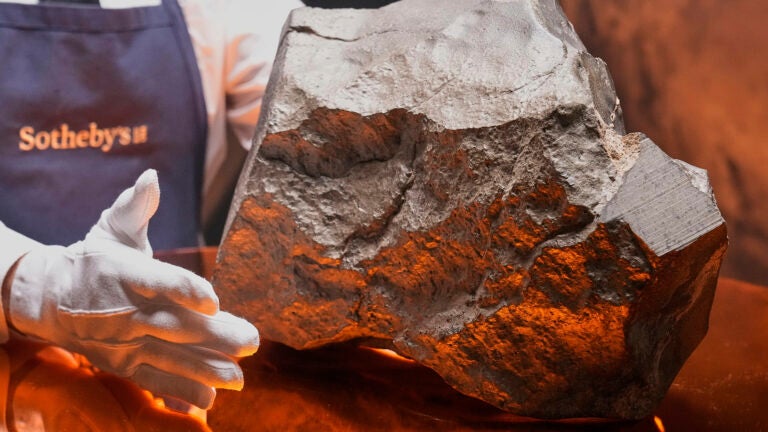
by NEW YORK (AP) — For sale: A 54-pound rock. Estimated auction price: $2 million to $4 million. Why so expensive? It’s the largest piece of Mars ever found on Earth.

Sotheby’s in New York will be auctioning what’s known as NWA 16788 on Wednesday as part of a
natural history-themed
sale that also includes a juvenile Ceratosaurus dinosaur skeleton that’s more than 6 feet tall and nearly 11 feet long.

According to the auction house, the meteorite is believed to have been blown off the surface of Mars by a massive asteroid strike before traveling 140 million miles to Earth, where it crashed into the Sahara. A meteorite hunter found it in Niger in November 2023, Sotheby’s says.
The red, brown and gray hunk is about 70% larger than the next largest piece of Mars found on Earth and represents nearly 7% of all the Martian material currently on this planet, Sotheby’s says. It measures nearly 15 inches by 11 inches by 6 inches (375 millimeters by 279 millimeters by 152 millimeters).
“This Martian meteorite is the largest piece of Mars we have ever found by a long shot,” Cassandra Hatton, vice chairman for science and natural history at Sotheby’s, said in an interview. “So it’s more than double the size of what we previously thought was the largest piece of Mars.”

It is also a rare find. There are only 400 Martian meteorites out of the more than 77,000 officially recognized meteorites found on Earth, Sotheby’s says.
Hatton said a small piece of the red planet remnant was removed and sent to a specialized lab that confirmed it is from Mars. It was compared with the distinct chemical composition of Martian meteorites discovered during the Viking space probe that landed on Mars in 1976, she said.
The examination found that it is an “olivine-microgabbroic shergottite,” a type of Martian rock formed from the slow cooling of Martian magma. It has a course-grained texture and contains the minerals pyroxene and olivine, Sotheby’s says.
It also has a glassy surface, likely due to the high heat that burned it when it fell through Earth’s atmosphere, Hatton said. “So that was their first clue that this wasn’t just some big rock on the ground,” she said.
The meteorite previously was on exhibit at the Italian Space Agency in Rome. Sotheby’s did not disclose the owner.
It’s not clear exactly when the meteorite hit Earth, but testing shows it probably happened in recent years, Sotheby’s said.
The juvenile Ceratosaurus nasicornis skeleton was found in 1996 near Laramie, Wyoming, at Bone Cabin Quarry, a gold mine for dinosaur bones. Specialists assembled nearly 140 fossil bones with some sculpted materials to recreate the skeleton and mounted it so it’s ready to exhibit, Sotheby’s says.
The skeleton is believed to be from the late Jurassic period, about 150 million years ago, Sotheby’s says. It’s auction estimate is $4 million to $6 million.
Ceratosaurus dinosaurs were bipeds with short arms that appear similar to the Tyrannosaurus rex, but smaller. Ceratosaurus dinosaurs could grow up to 25 feet (7.6 meters) long, while the Tyrannosaurs rex could be 40 feet (12 meters) long.
The skeleton was acquired last year by Fossilogic, a Utah-based fossil preparation and mounting company.
Wednesday’s auction is part of Sotheby’s Geek Week 2025 and features 122 items, including other meteorites, fossils and gem-quality minerals.
Collins reported from Hartford, Connecticut.
Sign up for the Today newsletter
Get everything you need to know to start your day, delivered right to your inbox every morning.